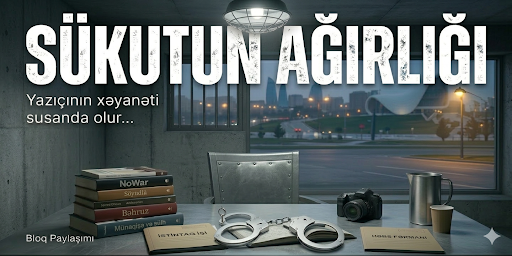
BAHRUZ SAMADOV - THE WEIGHT OF SILENCE
ENG:
I think a writer's betrayal happens in silence. If I have committed a betrayal, this was it.
Let's go back two years.
Again on an August day — not as the target of police cars waiting outside my home for me to leave, but after going to the police station myself, having my phone seized, and certain posts I had written about the police and the "Söyüdlü incident" deleted — I was released. A few days later, I was preparing to organize an event that no one had ever dared to hold before.
Both before and after the 2020 war, I had noticed that every event related to the conflict was held behind closed doors. When I asked why, they gave security as the excuse. I disagreed, and each time I called for events to be open to the public. I announced the presentation of the social theater I had previously organized, called "Colors of Conflict and Peace," as open to everyone. If we had long complained about the authorities holding negotiations behind closed doors and being opaque to the people, only to do the same ourselves — what difference would we have left? When I organized a discussion called "Why NoWar" for the last time, I thought along the same logic. Why couldn't the sides that had been hostile to each other on social media for years come together, openly express their views, and discuss? After all, we cannot achieve results without talking. Although a campaign was run against us for months after this event, and they said we were doing something on foreign orders, I say again now, as I declared then: this was simply our personal initiative. We had no financial interest and no connection to any organization.
This discussion made more noise than I had expected, and we ended up being the harbingers of a wave of arrests. A few months after us, Abzas and then other media outlets and NGOs faced the same wave of arrests on the same charges. The fact that I had not collaborated with any organization or media outlet helped me avoid arrest, but I understood that one day they would knock on my door too, and I would not get off so easily. Still, it was not the first time our tongues had gotten us into trouble.
From April 2024, rumors spread that there would be a wave of arrests targeting anti-war figures, but I did not quite believe in the credibility of this. More precisely, I saw no grounds for an arrest. I was deceiving myself with this, letting time pass.
The time came — August 21. When I heard late at night that my friend Bahruz Samadov had not been in contact for hours, anxiety crept in. (Bahruz Samadov is one of the political prisoners arrested in Azerbaijan. He was arrested on charges of "treason against the state" and sentenced to 15 years in prison.) Even though I did not want to consider arrest as a possibility, I was sure something had happened. And so it did. Bahruz had been detained. At first it was said he had been detained on drug charges, but we later learned he had been arrested under the charge of treason against the state. This was already the beginning of the end. When the SSS interrogated me and asked "if you had done nothing wrong, why were you leaving?", my only answer was "I had a bad feeling," because I knew Bahruz's arrest would not be short-lived. I wanted to avoid it, to stay safe somewhere outside for a while. It didn't work out. My friend and I had bought tickets and planned to leave on the same flight. When I arrived at the airport and cleared customs, I had relaxed a little. I thought I was safe now. Even though I told myself the unease inside me was just nerves, when I saw two people standing nearby glancing at a phone and then at me, I understood this was only the beginning. When they approached and said "There is a problem with your luggage. You need to come with us," I took out my phone and wallet without any resistance and handed them over myself, thinking "I know what the problem is, let's go." Before they even arrived, I had already managed to let my friend know that I had been detained.
Twenty-four hours without end. Questions without end.
I do not want to write every detail of what passed through my mind during those events. My intention is neither to frighten anyone by writing this, nor to relive those days and suffer a mental breakdown. I knew that the treatment I was receiving was still mild compared to what others had endured, but in a situation like that, under pressure, I do not know how resilient or heroic anyone can be. I tried as best I could to maintain my composure, and I wished for it to end quickly. When they told me at night that "a search will be conducted at your home," I did not know whether to be glad or dismayed. I would see my family, but I was unhappy because I did not want them to see me like this. They knew me, they trusted me, and they would be certain of my innocence — but I had no right to put them through this. When the search did not happen in the evening, I thought they would go in the morning, but they did not take me in the morning either. I learned the reason for that later. The aim was not to arrest me, but to create a pretext to arrest Bahruz in my name. However, what they overlooked were the writing mistakes they made while preparing the text. Because of those mistakes, everyone realized that I had not written it.
Bahruz.
My acquaintance with Bahruz, like with other friends, was through social media; we later met in the city and spent his limited days in Baku sharing a meal of kabab or pətənək, longing for home. He would come to Baku to visit his grandmother, his only remaining family there. Bahruz was different from other people I knew. That was the reason for our closeness. His different approach to events, his knowledge, and the positions he held that could drive a person to their wits' end sparked an interest in him in me. Even though we held different views and different ideologies, what brought us together was our love of conversation and history. We would read and discuss events from the 1990s and early 2000s. As I write this, I realize how much I miss those very conversations. I miss Bahruz's sentences that began with "terrible" and "frightening."
Although my interrogations were conducted multiple times in different rooms by different individuals, the lead interrogators were always either present with me or coming and going to check. The questions, however, never changed. What did you do together with Bahruz? What connections did you have with Armenians?
I thought about this a great deal even after being released — what kind of connection or knowledge of mine could they possibly evaluate within the framework of "espionage" or "treason"? I was a writer who wrote what he thought, and who was criticized by his very own readers for what he wrote. The reactions I received for trying to be not a writer beloved by the people, but one who toppled their ideas and sought to open new paths, were not strong enough to make me change my mind. I have been writing for over ten years, and I have always been someone who tried to knock over the beehive. Because I knew the work I was doing demanded it. Revolution begins with an idea. Whether when I spoke out against the war, or in other positions I expressed, I sometimes became an object of condemnation by pro-government voices alone, and sometimes by everyone — opposition and government supporters alike. That was in fact something I wanted. It meant the words I said had had an effect.
There was not much common ground that would connect Bahruz and me, so there was nothing for me to tell them either. There had been one joint discussion we had both attended, where only history, creating alternative history, and reducing hate speech were discussed. Even that conversation could not be called "treason against the state." When they asked me "How well do you know Bahruz that you also think he is not a traitor?", the only answer I could give was "You simply trust and believe in a person." A sincere person, even if their intentions are bad, will show it — and that is who I am. Bahruz was an academic person. The things he loved were researching, reading, learning, discussing what he learned, and having a beer with pətənək at the pub. I had never thought that Bahruz had either the interest or the intent to get involved in something like this. Suppose he had — would a person doing such a thing come back to the country? Especially if he had already been detained and interrogated by the SSS once before his arrest. His sense of ease came from exactly that. He said he was clean, that there was no basis for his arrest. He did not take our insistence that he not come seriously. He came, and let himself be caught. Bahruz was pure. He had believed their promise of "we will not arrest you."
Even now I would say "no" to the question "Do you agree with all of Bahruz's views?" — but I cannot deny that Bahruz's views were valuable. He had written a letter, and he had written it so academically that it was not possible to read it once and understand. Seeing a person who had devoted his life to education now likely to rot away his life in prison disturbs me greatly.
The questions directed at me beyond those about Bahruz were usually about my writings and their titles. They would point to the nuances I had touched upon and tell me I was "someone who hated Azerbaijan." For me, a person is a person. The nation they belong to or the language they speak does not make them superior or inferior to another. Some may disagree with this view, perhaps, but if we are talking about human rights, how can we think otherwise? I was against making young people who had no connection to past conflicts, wars, and tragedies pay the price for them. I said I could not accept a young person who had never met an Azerbaijani or an Armenian in their life being filled with hatred and becoming an enemy of the other side. The argument that silenced me — and which I accepted as valid in a certain sense — was that for all the noise we were making, Armenians had for years not made a sound. When they said "Where are their Bahruz Samadovs, their Samad Shikhis?" I had to fall silent: "you are right." Since the 1990s, how many Armenians had spoken up for Azerbaijanis who were condemned, displaced, killed, whose homes were taken from them? What made me right while also making me stronger was that I expressed my views without expecting anything in return from anyone. During the interrogation, I was asked questions about other people I knew or did not know who held oppositional positions — they were trying to find out whether I knew them. My answer to questions about what I knew of them was nothing beyond what I could say on a personal level. Because I had never tried to get close enough to anyone that I would know secrets about them.
Even though I handed over my phone at the airport, there was no access to any of my social media accounts. They had reset the passwords using my phone number and accessed them to conduct checks themselves. Later, when they saw nothing remained on my phone, they taunted me by saying "you came prepared."
When the charge placed before me was Article 274 — "treason against the state" — I had already accepted that everything was over for me. Among the pages of a book tearing apart in my mind, the heaviest had fallen to me. And without any guilt whatsoever. Just like my friend. Once I had the chance to review the criminal case, I was freed from the question "Has Bahruz actually done something?" I saw no grounds for treason, nothing to justify holding him criminally liable. What had made him a traitor was having talked and debated with an Armenian.
They would pull out each of my different writings from the file in their hands and ask who had commissioned me to write that piece. The majority of the writings they showed me were articles I had shared on the website I had created after selling my personal library. I had sold over 200 books to build that website. The other writings were articles published in various media outlets, or my social media posts. I had an answer for each of them, but I understood that it did not satisfy them. The answer they were expecting was not something I had.
During the conversations, I paid attention to the way they spoke and their movements, trying to analyze them as a writer. I was trying to understand what kind of character they possessed, what their thinking was. Some were sharper-minded, trying to twist words out of me, while some struck me as very simple. The strangest thing of all was that regardless of how they behaved toward me, every single one of them addressed me formally, using the polite "you."
Hours passed, each spent in a different room, trying to prove to different people that I was innocent. After a while I had grown tired and bored of giving the same answers, so I switched to short replies. I understood that those present were not the ones who would decide my fate — they were simply there to watch over me. I waited without knowing what would become of me. In the last room they kept me in, after giving me chicken strips and a Coca-Cola, a different person came to me and told me I would be released shortly, but that I was not permitted to post anything or give any interviews until notified. Then, showing me a post that had been made from my well-known Facebook account right there in front of me, he said "this will not be deleted from here, and if it is deleted, you will be brought back" — and with that, I was taken outside and sent home in a taxi they had called. I later learned that the statement taken from me was exactly the same as what was written in that post. Although the events described in that text were true, its framing was wrong. Bahruz had invited me to the meeting in Georgia, but he had not covered my expenses. Bahruz himself was someone who got by on his scholarship and his grandmother's pension. Why would he have covered my expenses?
I later learned that Cavid Agha had also been detained at the airport. Although the two of us were the ones highlighted and known publicly, other young people had also been questioned as witnesses. Special attention was paid to our shared group that included Bahruz — SAMQ. In that group we simply had everyday conversations, laughed and talked. They had referenced that group in the criminal case as well.
As I was being sent off, he told me I had a travel ban and would not be able to go anywhere. You might ask: why didn't you delete the post, why didn't you issue a denial? I was afraid. If that is what you want to hear, I will say it. Yes, I was afraid. Think of the weight of the place where I had spent 24 hours, and the weight of each hour I passed through — perhaps then you will understand a little of what I mean. By the time I got home, it had been more than two days since I had slept. I was exhausted, weak, and worn out. But as I entered the house, I realized how strange it was that I was smiling. After coming to myself, I met with my lawyer and tried to understand what I should do and what might happen to me. The conclusion I reached was silence. As far as it goes, let it go. These months spent in silence taught me a great deal. They helped me learn about people, to analyze from the outside. I lived through those days with all their difficulty, pain, and experience. For months I was unable to write anything, unable even to read a book. Even though I could see the harm in shutting myself away, I was not trying to escape it. When I learned that my name had been removed from the criminal case as a witness, I asked my lawyer: is this a good thing or a bad thing? When he said "It won't be a good thing — in all likelihood a separate criminal case has been opened against you," I understood that the time had come and I prepared myself for it. I made my plans for what to do, and I waited. Even when I learned that my travel ban had been lifted, I could not feel joy about it. Because as someone who had already been detained while leaving the country, I thought in my heart that it could happen a second time. I went to the airport, I cleared customs. My heart was still uneasy. My eyes were searching for people watching me. I sat down on the plane and waited. When the plane took off, I understood: it was over.
Bahruz is in prison now. Sooner or later he will be free. We will sit around a table together and talk again. I believe this. I have missed my conversations with Bahruz. Sometimes I come across an article, a video appears before me, and I realize this is something I could only discuss with Bahruz — and it stays locked in my heart. I long to return to those conversations again. I hope I will not have to wait long for those days.
AZE:
Yazıçının xəyanəti susanda olur deyə düşünürəm. Etdiyim bir xəyanət olubsa, o da bu olub.
2 il geri gedək.
Yenə bir avqust günü, evimin qarşısında mənim evdən çıxmağımı gözləyən polis maşınlarına hədəf olmasam da, özüm getdiyim polis bölməsində telefonuma əl qoyularaq, yazdığım bəzi polis və “Söyüdlü hadisəsi” ilə bağlı postlar silinəndən sonra sərbəst buraxıldım. Bundan bir neçə gün sonra isə heç kəsin bu günə qədər etməyə cəsarət etmədiyi, çəkindiyi bir tədbirin təşkilatına hazırlaşırdım.
İstər 2020-ci il müharibəsindən əvvəl, istərsə də sonrasında fikir verirdim ki, münaqişə ilə bağlı keçirilən tədbirlərin hər biri qapalı keçirilir. Bunun səbəbini soruşanda isə təhlükəsizlik bəhanəsini deyirdilər. Bununla razılaşmır, hər dəfə bunu ictimaiyyətə açıq olduğunu çağırırdım. Daha əvvəl təşkil etdiyim “Münaqişə və sülhün rəngləri” adlı sosial teatrın təqdimatını hər kəsə açıq elan etdim. İllərdir hakimiyyətin danışıqları qapalı etməyindən, xalqa şəffaf olmamağından gileylənib, daha sonra eynisini edəcəyiksə, daha nə fərqimiz qaldı ki? Sonuncu dəfə də “Niyə NoWar” adlı müzakirə təşkil edərkən eyni məntiqlə düşündüm. İllərdir sosial mediada bir-birilərinə qarşı düşmənçilik edən tərəflər niyə toplaşıb, fikirlərini açıq ifadə edib, müzakirə etmirlər? Axı danışmadan nəticə əldə edə bilmərik. Bu tədbirdən sonra aylarla haqqımızda kampaniya aparılsa da, bizi xaricdən sifariş əsaslı nəsə etdiyimizi desələr də, o vaxt bəyan etdiyim kimi, yenə deyirəm ki, bu sadəcə şəxsi təşəbbüsümüz idi. Heç bir maddi maraq və təşkilatla əlaqəmiz olmamışdı.
Bu müzakirə düşündüyümdən artıq səs saldı və nəticədə bir həbs dalğasının xəbərçisi olduq. Bizdən bir neçə ay sonra isə eyni ittihamlarla Abzas və davamında digər medialar, QHT-lər həbs dalğasına məruz qaldı. Heç bir təşkilat və media ilə əməkdaşlıq etməməyim məni həbslərdən yayındırsa da, başa düşürdüm ki, mənim qapımı da nə zamansa, döyəcəklər və mən elə də asan qurtulmayacam. Di gəl, dilimizin bəlasına ilk dəfə düşmürdük.
2024-cü ilin aprel ayından artıq müharibə əleyhdarlarına qarşı bir həbs dalğası olacağı söhbəti yayılsa da, bunun etibarlılığına elə də inanmırdım. Daha doğrusu həbs üçün heç bir əsas görmürdüm. Bununla özümü aldadır, vaxtı ötürürdüm.
Vaxt gəldi çatdı 21 avqusta. Gecə dostum Bəhruz Səmədovdan xəbər olmadığını, saatlarla əlaqə saxlanmadığını eşidəndə narahatçılıq basmışdı (Bəhruz Səmədov–Azərbaycanda həbs edilən siyasi məhbuslardan biridir. O, “dövlətə xəyanət” maddəsiylə həbs edilib, 15 il azadlıqdan məhrum edilib). Həbsinə ehtimal vermək istəməsəm də, nəsə olduğundan əmin idim. Elə də oldu. Bəhruz saxlanmışdı. Əvvəlcə narkotiklə saxlandığı deyilsə də, daha sonra onun dövlətə xəyanət maddəsi ilə saxlandığını öyrəndik. Bu artıq sonun başlanğıcı idi. Məni DTX-da dindirərkən “əgər heç bir günahın yox idisə, niyə gedirdin?” deyə soruşanda cavabım sadəcə “ürəyimə dammışdı” idi, çünki Bəhruzun həbsinin davamlı olacağını bilirdim. Bundan isə yayınmaq, bir müddət kənarda təhlükəsizlikdə qalmaq istəyirdim. Baş tutmadı. Dostumla bilet alıb, eyni təyyarə ilə getməyi planlaşdırdıq. Mən hava limanına çatıb, gömrük xidmətindən keçəndə biraz rahatlamışdım. Artıq təhlükəsizdə idim deyə düşünürdüm. İçimdəki narahatçılığın sadəcə həyəcandan olduğunu düşünsəm də, kənarda dayanmış 2 şəxsin telefona, daha sonra mənə baxdığını görəndə başa düşdüm ki, bu hələ başlanğıcdır. Mənə yaxınlaşıb, “Baqajınızda problem var. Bizimlə gəlməlisiniz” deyəndə əziyyət vermədən telefon və pulqabımı çıxarıb, özüm verdim ki, “bilirəm problemi, gedək”. Onlar gələnə qədər artıq dostuma xəbər vermişdim ki, məni saxladılar.
Bitməyən 24 saat. Bitməyən suallar
Başımdan bu hadisələr keçdi deyə hər detalı yazmaq istəmirəm. Yazıb nə kimisə qorxutmaq, nə də özümdə həmin günləri təzədən xatırlayıb, əsəb pozğunluğu yaşamaq fikrim yoxdur. Bilirdim ki, hələ mənə olan münasibət digərləri ilə müqayisədə hələ az idi, amma elə situasiyada, təzyiq altında kim nə qədər dözümlü və qəhrəman ola bilər bilmirəm. Əlimdən gəldiyi qədər təmkinliyimi qorumağa çalışır, tez bitməyini arzulayırdım. Gecə mənə “evə axtarışa gediləcək” deyiləndə buna sevinimmi, pis olummu bilmədim. Evdəkiləri görəcəkdim, amma onların məni elə görməyini istəmirdim deyə pis olmuşdum. Onlar məni tanıyır, məni bilirdi deyə günahsız olduğumdan da əmin olacaqdılar, amma onlara bunu yaşatmağa haqqım yox idi. Axşam axtarışa getmədikdə, səhər gedəcəyimizi düşündüm, amma səhər də aparmadılar. Niyəsini isə sonra öyrəndim. Məqsəd mənim həbsim deyil, mənim adımdan Bəhruzun həbsinə motiv hazırlamaq imiş. Diqqət etmədikləri şey isə yazını hazırlayarkən etdikləri yazı səhvləri idi. Buna görə yazını mənim yazmadığımı hər kəs bilmişdi.
Bəhruz.
Bəhruzla tanışlığım digər dostlar kimi sosial media üzərindən olub, daha sonra şəhərdə görüşərək kafedə ya kabab yeyərək, ya da “pətənək həsrəti” ilə onun sayılı Bakı günlərini ötürərdik. Bakıya ailəsindən tək qalan fərdi olan nənəsini görmək üçün gəlirdi. Bəhruz tanıdığım digər insanlardan fərqli idi. Onunla olan yaxınlığımın səbəbi də bu idi. Hadisələrə fərqli yanaşmağı, məlumatlılığı, adamı özündən çıxaracaq mövqeləri məndə ona qarşı maraq oyadırdı. Fərqli fikirlərdə, fərqli ideologiyalarda olsaq da, bizi söhbət etmək sevgimiz, tarix birləşdirirdi. Bir-birimizlə 90-cı illərdə, 2000-ci illərin əvvəlində olan hadisələri oxuyub, müzakirə edirdik. Bu mətni yazarkən necə də həmin söhbət üçün darıxdığımı başa düşürəm. Bəhruzun “qorxulu”, “dəhşətli” deyə başlayan cümlələri üçün darıxmışam.
Dindirməm fərqli otaqlarda, fərqli şəxslər tərəfindən dəfələrlə aparılsa da, əsas istintaqı aparan şəxslər ya yanımda olurdu, ya da gedib-gəlib yoxlayırdı. Suallar isə dəyişmirdi. Bəhruzla birlikdə nə etmisən? Ermənilərlə nə əlaqələrin olub?
Bunu çıxandan sonra da çox düşünmüşdüm ki, mənim necə bir əlaqəm, məlumatlılığım ola bilərdi ki, bunu “casus” və ya “xəyanət” çərçivəsində dəyərləndirsinlər. Düşündüyünü yazan, yazdığı üçün elə oxucusu tərəfindən qınadılan yazıçı idim. Mən xalqın sevimlisi olmağı deyil, xalqın fikirlərini yıxıb, yenilik açmağa çalışan yazıçı olmağa çalışdığımdan gələn reaksiyalar fikrimdən döndərəcək dərəcədə güclü deyildi. Mən 10 ildən artıqdır ki, yazıram və həmişə arı yeşiyini dağıtmağa çalışan birisi olmuşam. Çünki gördüyüm işin bunu tələb etdiyini bilirdim. İnqilab fikirdən başlayır. İstər müharibə əleyhinə çıxdığım zaman, istərsə də bildirdiyim digər münasibətlər zamanı bəzən tək hakimiyyətmeyllilər tərəfindən, bəzən isə müxalif, iqtidarçı hər kəs tərəfindən qınaq obyektinə çevrilirdim. Əslində bu istədiyim bir şey idi. Deməli, dediyim sözün təsiri olub.
Bəhruzla isə məni birləşdirəcək çox da ortaq məcra yox idi deyə onlara danışacaq nə isə də yox idi. Bir dəfə qatıldığımız ortaq müzakirə olmuşdu ki, orda da ancaq tarix, alternativ tarix yaratmaq, nifrət nitqini azaltmaqdan danışılıb. O söhbəti isə yenə “dövlətə xəyanət” adlandırmaq mümkün deyildi. Məndən “Bəhruzu nə qədər tanıyırsan ki, onun satqın olmadığını da düşünürsən” deyə soruşanda verə biləcəyim tək cavab “birisinə qarşı sadəcə güvənərsən və inanarsan” olmuşdu. Səmimi insan niyyəti pis də olsa, bunu göstərər ki, mən buyam. Bəhruz akademik insan idi. Onun sevdiyi şeylər araşdırmaq, oxumaq, öyrənmək, öyrəndiklərini müzakirə etmək və pub-da pivə ilə yanında pətənək idi. Bəhruzun belə bir işə girişəcək nə marağı, nə də fikri olduğunu düşünməmişəm. Fərz edək ki, düşünüb, onu edən şəxs ölkəyə gələrdimi? Xüsusilə də həbsindən əvvəl gəldiyi zaman bir dəfə DTX tərəfindən saxlanılıb, dindirilmişdisə. Onun rahatlığı da bundan gəlirdi. Özünün təmiz olduğunu, həbsinə əsas verəcək nəyinsə olmadığını deyirdi. Bizim “gəlmə” təkidlərimizi də ciddiyə almadı. Gəldi və özünü tutdurdu. Bəhruz saf idi. Onların “biz səni tutmayacağıq” vədinə inanmışdı.
“Bəhruzun bütün fikirləri ilə razısanmı?” sualına indi də “xeyr” deyərəm, amma Bəhruzun fikirlərinin dəyərli olduğunu da inkar edə bilmərəm. Məktub yazmışdı, məktubu da o qədər elmi yazmışdı ki, bir dəfəyə oxuyub, başa düşmək mümkün deyildi. Ömrünü təhsilə vermiş bir şəxsin indi ömrünü həbsdə çürüyəcəyini görmək məni çox narahat edir.
Mənə ünvanlanan Bəhruzdan kənar suallar isə, adətən, yazılarım və onların başlıqları idi. Toxunduğum nüansları misal göstərir, məni “Azərbaycana nifrət edən birisi” olduğumu deyirdilər. Mənim üçün insan insandır. Onun hansı millətə mənsub olduğu, hansı dildə danışdığı digərindən üstün və ya alçaq olduğu mənasına vermirdi. Kimisi bu fikirlə razılaşmaz bəlkə, amma insan haqlarından danışırıqsa, bunun əksini necə düşünə bilərik? Keçmişdə baş vermiş münaqişənin, müharibənin, faciələrin cəzasını da bu münaqişələrə aidiyyatı olmayan gənclərə ödətilməsinin əleyhinə idim. Həyatında bir dəfə azərbaycanlı/erməni görməyən gəncin qarşı tərəfə nifrət edib, düşmən olmağını qəbul etmədiyimi deyirdim. Məni susduran, bir baxımdan da haqlı olduqlarını qəbul etdiyim fikir isə bizim çıxardığımız səs qədər ermənilərin illər boyu səs çıxarmaması idi. “Hardadır onların Bəhruz Səmədovu, Səməd Şıxısı?” deyəndə susmalı olurdum ki, “haqlısız.” 90-cı illərdən bəri münaqişəni pisləyən, köçürülən, öldürülən evləri əllərindən alınan azərbaycanlıların haqqında nə qədər erməni səs çıxarmışdı ki? Məni haqlı etməklə yanaşı, güclü edən isə mən kimdənsə qarşılıq gözləmədən fikirlərimi deməyim idi. Sorğu zamanı tanıdığım və ya tanımadığım müxalif mövqeli başqa insanlar haqda suallar verilir, onları tanıyıb, tanımadığımı öyrənməyə çalışırdılar. Onlar haqda nə bilirsən sualına isə şəxsi zəmində verəcəyim cavabdan başqa heç nə yox idi. Çünki heç kəsi onlar haqda sirr biləcək qədər yaxından tanımağa çalışmamışdım.
Telefonumu məni hava limanında saxlayarkən versəm də sosial media hesablarımın heç birinə giriş yox idi. Şifrəni nömrəmlə bərpa edib, özləri daxil olub yoxlamaya almışdılar. Daha sonra telefonumda heç nəyin qalmadığını görüb, hazırlıqlı gəlmisən deyə mənə söz atırdılar.
Qarşıma artıq 274-cü maddə olan “dövlətə xəyanət” maddəsi qoyulanda artıq hər şeyin mənim üçün bitdiyini qəbul etmişdim. Başımda cırıq-cırıq olan kitabın dağılan səhifələri arasında mənə onların ən ağırı düşmüşdü. Həm də heç bir günahım olmadan. Eynilə dostum kimi. Cinayət işiylə ilk fürsətdə tanış olub, “Bəhruz həqiqətən nəsə edibmi?” sualından qurtuldum. Onun əməlində nəki xəyanət, heç bir məsuliyyətə cəlb olunacaq əsas görmədim. Erməni ilə söhbət etməyi, müzakirəsi onu xain etmişdi.
Əllərindəki fayldan hər fərqli yazımı çıxarır, bu yazını kimin sifarişi ilə yazdığımı soruşurdular. Göstərdikləri yazıların əksəriyyəti isə şəxsi kitabxanamı satıb, yaratdığım saytımda paylaşdığım yazılar idi. Həmin saytı qurmaq üçün 200-dən artıq kitabımı satmışdım. Digər yazılar isə fərqli medialarda paylaşılan məqalələr idi, ya da sosial media postlarım. Hər birinə veriləcək cavabım olsa da, bunun onları qane etmədiyini başa düşürdüm. Gözlədikləri cavab isə məndə yox idi.
Söhbət zamanı onların danışığına, hərəkətlərinə diqqət edir, onları bir yazıçı kimi analiz etməyə çalışırdım. Onların necə bir obraza sahib olduğunu, düşüncələrini öyrənməyə çalışırdım. Bəziləri daha çevik düşüncədə, sözdən söz qoparmağa çalışan olsa da, bəzilərinin çox sadə görüntüdə olduğunu hiss edirdim. Ən qəribə gələn isə mənimlə davranışlarından asılı olmayaraq hər biri mənə “siz” deyə müraciət edirdi.
Saatlar keçir, hər saatı artıq fərqli otaqda keçirib, fərqli şəxslərə günahsız olduğumu isbat etməyə çalışırdım. Bir yerdən sonra yorulub, eyni cavabları verməkdən sıxılmışdım deyə qısa cavablarla keçirdim. Başa düşürdüm ki, haqqımda qərar verəcək şəxslər deyil, sadəcə mənə nəzarət etmək üçün yanımdaydılar. Aqibətimin nə olacağını bilmədən gözləyirdim. Sonuncu saxladıqları otaqda mənə toyuq langeti və Coca Cola verdikdən sonra yanıma gələn daha fərqli bir şəxs mənə birazdan sərbəst buraxılacağımı, amma xəbər verilməyənə qədər nə paylaşım etməyə, nə də müsahibə verməyə icazəmin olmadığını təmbeh etdi. Daha sonra məşhur Facebook hesabımdan edilən paylaşımı yanımda paylaşaraq bu buradan silinməyəcək, silinsə geri dönəcəksən deyilərək məni oradan çölə çıxarıb, çağırdıqları taksi ilə evə göndərildim. Sonra öyrəndim ki, məndən götürülən ifadə elə tam olaraq postda yazılanla eynidir. Həmin mətndəki hadisə doğru olsa da, yanaşması düzgün deyil. Gürcüstandakı görüşə Bəhruz məni dəvət etmişdi, amma xərcimi qarşılamamışdı. Bəhruzun özü stipendiyası və nənəsinin aldığı pensiya ilə dolanan birisi idi. Mənim niyə xərclərimi qarşılamalı idi?
Sonra öyrəndim ki, Cavid Ağanı da hava limanında saxlamışdılar. İşıqlandırılan və bilinən ikimiz olsaq da, şahid kimi başqa uşaqlar da dindirilmişdi. Xüsusi diqqət isə Bəhruzun da olduğu ortaq qrupumuz - SAMQ idi. Hansı ki, o qrupda sadəcə gündəlik söhbətlər edir, deyib-gülürdük. Həmin qrupu cinayət işində də qeyd etmişdilər.
Göndərilərkən isə ölkədən çıxış qadağamın olduğunu, harasa gedə bilməyəcəyimi dedi. Deyə bilərsiniz ki, postu niyə silmədin, niyə təkzib etmədin? Qorxdum. Əgər eşitmək istədiyiniz budursa, deyim. Bəli, qorxdum. 24 saat olduğum məkanın ağırlığını və keçirdiyim hər saatın ağırlığını düşünün, bəlkə biraz başa düşərsiniz dediyimi. Evə çatanda artıq 2 gündən artıq idi ki, yatmırdım. Yorğun, halsız, kefsiz idim. Amma evə daxil olarkən gülməli olduğumu başa düşürdüm. Özümə gələndən sonra vəkilimlə görüşüb, nə etməli olduğumu, başıma nəyin gələ biləcəyini öyrənməyə çalışdım. Gəldiyim nəticə isə sükut oldu. Hara qədər gedəcəksə, ora qədər. Sükutla keçirdiyim bu aylar mənə çox şey öyrətdi. İnsanları tanımağa, kənardan analiz etməyə kömək oldu. Çətinliyi ilə, ağrısı ilə, təcrübəsi ilə günləri keçirdim. Aylarla heç nə yaza bilmədim, kitab oxuya bilməyəcək vəziyyətə düşmüşdüm. Özünə qapanmağın zərərlərini görsəm də, bundan qurtulmağa çalışmırdım. Cinayət işindən şahid kimi adımın çıxarıldığını biləndə isə vəkilimdən soruşdum. Bu yaxşı bir şeydirmi, yoxsa pis bir şeydirmi? “Yaxşı şey olmayacaq, böyük ehtimal sənin üçün ayrıca cinayət işi açılıb” deyiləndə zamanın gəldiyini düşünüb, ona hazırlaşmışdım. Nə edəcəyimi planlayıb, gözlədim. Ölkədən çıxış qadağamın götürüldüyünü öyrənəndən sonra da buna sevinə bilməmişdim. Çünki ölkədən çıxdığım halda saxlanmış bir şəxs olaraq ikinci dəfə ürəyimdə qala biləcəyini düşünmüşdüm. Hava limanına getdim, gömrüyü keçdim. Yenə ürəyim rahat deyildi. Gözüm məni güdən insanları axtarırdı. Təyyarəyə əyləşdim, gözlədim. Təyyarə havaya qalxanda başa düşmüşdüm ki, artıq bitdi.
Bəhruz indi həbsdədir. Gec, ya tez azadlığa çıxacaq. Onunla yenə bir masa ətrafında söhbət edəcəyik. Buna inanıram. Bəhruzla söhbətlərimiz üçün darıxmışam. Bəzən bir yazı tapıram, bir video çıxır qarşıma, başa düşürəm ki, bunu tək Bəhruzla söhbət edə bilərəm, ürəyimdə qalır. Yenidən o söhbətlərə dönmək üçün darıxıram. Ümid edirəm çox gözləməyəcəm o günləri.